
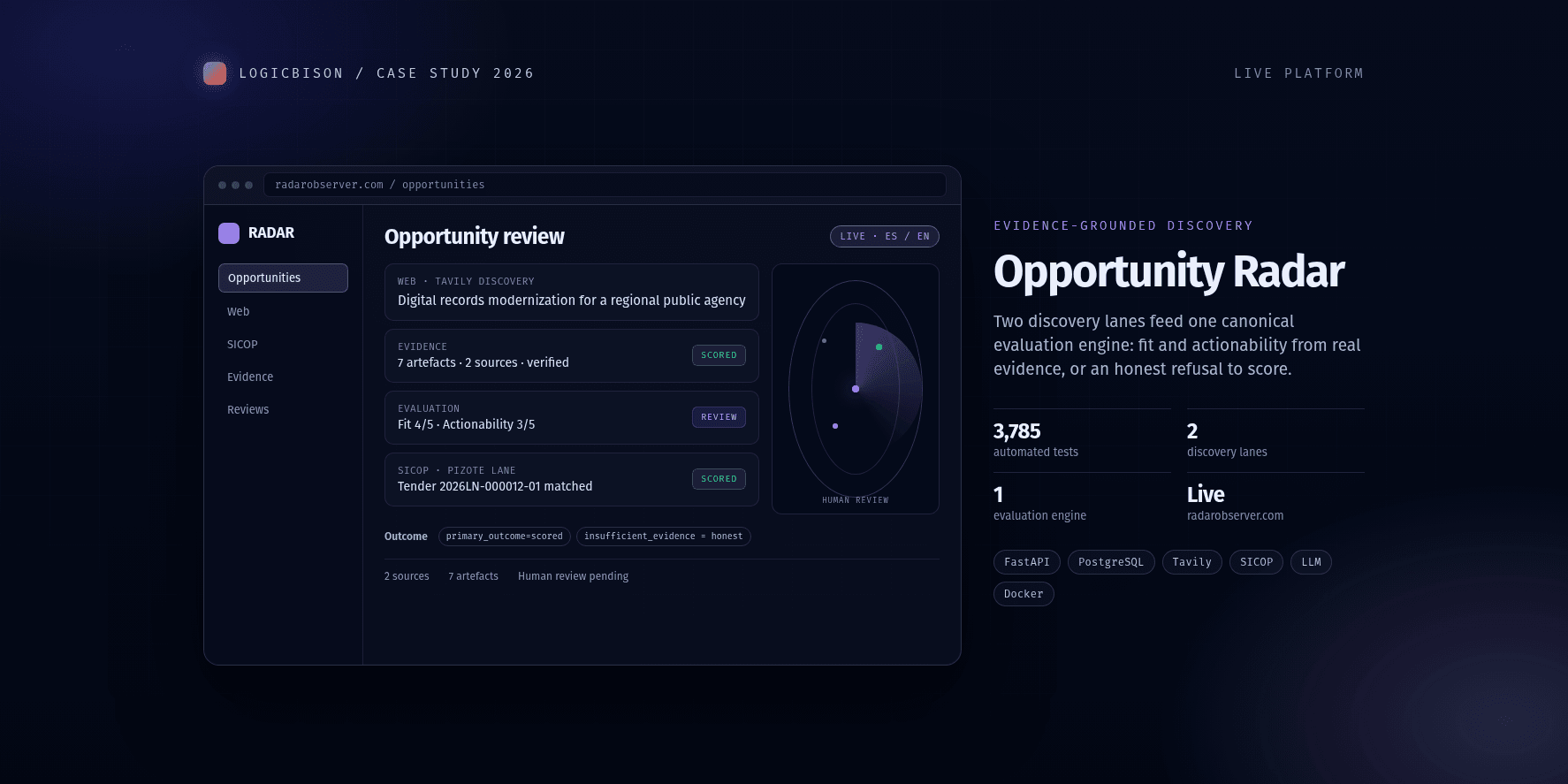
Opportunity Radar: Evidence-Grounded Discovery
A live platform that discovers commercial opportunities from the web and SICOP, then evaluates them with evidence instead of a black-box score.
Every opportunity tool promises more leads. More leads is the wrong metric. The expensive failure is a confident score attached to an opportunity nobody can verify, because it sends a person to a meeting with nothing to stand on.
Opportunity Radar separates discovery from judgment. A source discovers a candidate. The platform evaluates it against explicit, evidence-anchored rules, with deterministic composition and structured semantic judgments. If the evidence is missing, the output says so. The live product runs at radarobserver.com.
The Problem
Manual opportunity research does not scale, and naive automation hallucinates fit. A model asked to score an opportunity will produce a number even when the source page is thin, the deadline is unclear, or the buyer is wrong. The result looks like a pipeline and behaves like noise.
The requirement was a shortlist a person could defend: why this opportunity, what evidence supports it, and what to do next.
The Approach
Two independent discovery lanes feed one shared core. The general web lane uses Tavily to discover and qualify candidates. The SICOP lane receives tender candidates from Pizote. Both cross a promotion boundary into the same canonical objects: Opportunity, SourceObservation, and EvidenceArtifact.
Evaluation then runs in two dimensions, fit and actionability, using deterministic composition plus evidence-grounded semantic judgments. There is no numeric black-box score. Workspace, tenant, and user scope sit around the core, with a Web-only operator role restricted server-side and an admin console.
The stack is FastAPI, PostgreSQL, and Docker, with the UI in Spanish and English. The suite held 3,785 passing tests at the last full gate.
The Outcome
Live at radarobserver.com. Both lanes have been exercised end to end through the same evaluation engine: one real opportunity reached a scored result and one produced an honest insufficient-evidence outcome. The product is built with a team, 257 commits across two months, and the UI runs in Spanish and English.
The human decision is still the last step. That is the design, not a gap.
Open Opportunity Radar
Live platform. Sign in with a workspace account; the public page shows the opportunity feed and the sign-in.
Key Takeaway
The valuable part is not finding more opportunities. It is refusing to score the ones the evidence cannot support.
Ready to Build Your Platform?
One 30-minute call to see if I'm the right fit. No pitch. No pressure. In English or Spanish, just a conversation about what you need to build.
Every engagement is scoped and quoted individually. There is no rate card, and no price before I understand the system. The first step is a 30-minute call, in English or Spanish; you leave it with a clear read on scope, sequence, and what the work would take.