
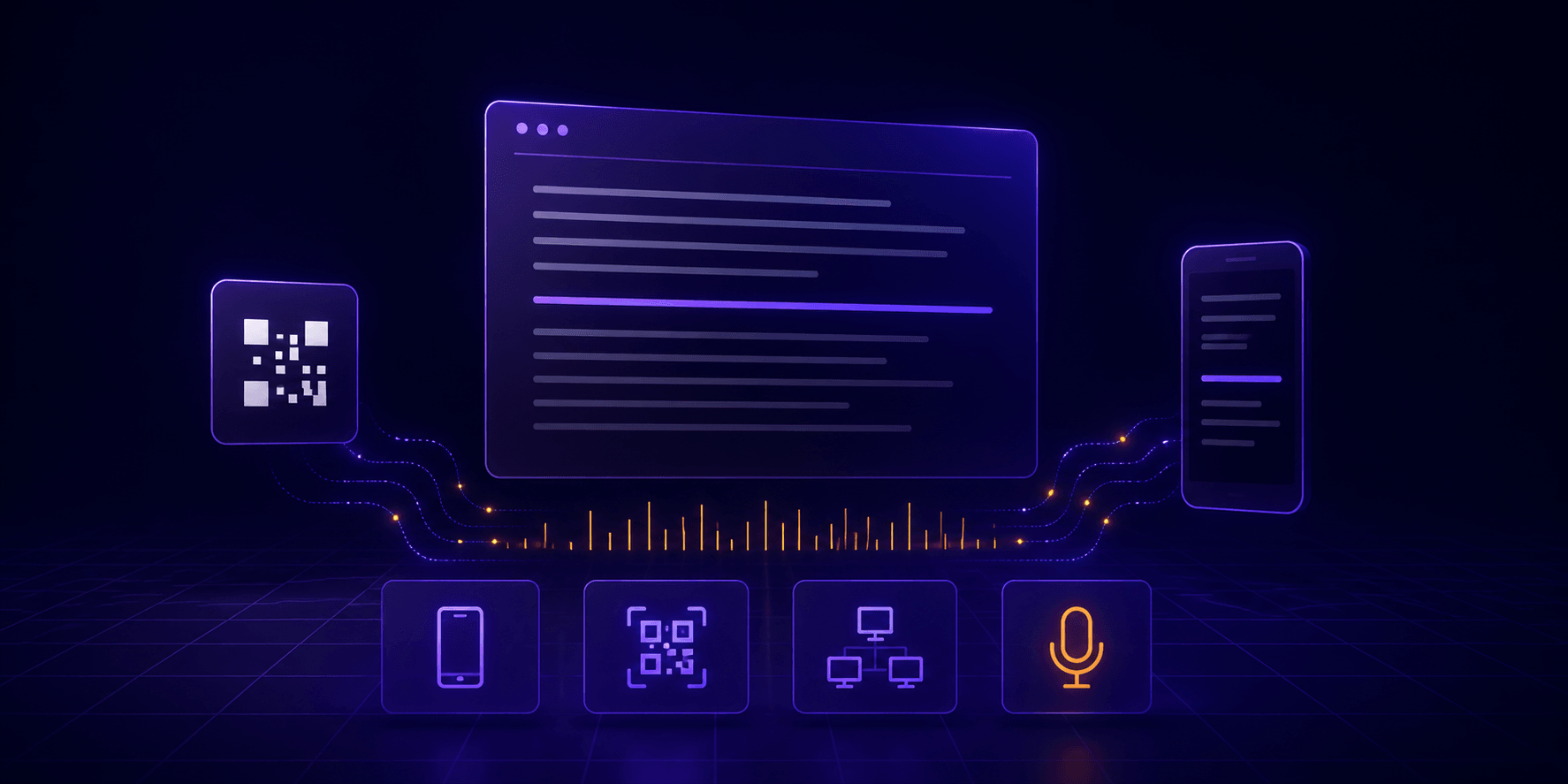
Web Teleprompter — Self-Hosted PWA with Browser-Only Speech Sync
A privacy-first teleprompter now live at teleprompt.aiepic.app: paste a script, hand it to any device via QR, and let the browser keep the scroll in sync with your voice
Speakers and creators needed a teleprompter they could run on their own machine, take offline, and hand a script to a second device without an account. Existing tools were either cloud-dependent, multi-device-incompatible, or both.
The result is a privacy-first PWA, shipped as a free, public instance at teleprompt.aiepic.app. Scripts live in the browser, the relay server forgets everything in minutes, and the speech sync that follows your voice uses only the browser's built-in Web Speech API — your mic and your script never leave the device unless you explicitly choose a server-assisted handoff mode.
The Problem
The user need was concrete: prepare a script on a laptop, send it to a phone or tablet, and present from that device in fullscreen — without installing an app, creating an account, or trusting a SaaS with the script.
Three constraints made the existing market useless. (1) Cloud tools stop working offline. (2) Multi-device tools require a shared backend, which means an account, which means the script lives on someone's server. (3) Voice-following teleprompters relied on cloud speech-to-text, which streams your audio to a vendor — a non-starter for anyone presenting confidential or embargoed material.
The Approach
A Vite + React 19 PWA for the editor and player, a tiny FastAPI service for the optional relay, Redis for the relay store (5-minute TTL, delete-on-read), and Caddy as the reverse proxy with full security headers. No database, by design.
The recommended day-to-day flow is intentionally simple:
1. Open the app on a computer — the public instance or your own deploy.
2. Load the script by uploading a file or pasting text; it is kept in the browser's local storage, not as a permanent server file.
3. Hand off to the phone: open Handoff, generate the QR code(s), and scan them with the mobile device. For typical scripts this uses single QR or multi-QR, so the script is encoded in the URL fragment and never stored on the server.
4. Read on the phone: the player opens, and you tune speed, font size, theme, and mirror to the room.
5. Optional speech sync: tap the language control (ES / EN) and Chrome's built-in Speech Recognition scrolls the text as you speak. No streaming ASR service is required or bundled.
Four handoff modes with automatic fallback cover edge cases:
- Single QR — payload embedded in a URL fragment, never sent to the server. The usual case for small scripts.
- Multi-QR — scan codes in any order for scripts past the single-QR limit.
- LAN link — same Wi-Fi, no server hop at all.
- Relay + OTP — for very large scripts, the server holds the payload briefly with a one-time password.
For public hosts, server-assisted modes can be disabled entirely (DISABLE_SERVER_HANDOFF=true), leaving only QR-based handoffs and guaranteeing that no user script touches the server.
Markdown is rendered through markdown-it + DOMPurify with raw HTML stripped at input. A full GitHub Actions CI gate runs lint, typecheck, unit, and Compose validation on every push.
The Outcome
Shipped as v0.5.0 and live at teleprompt.aiepic.app. The app is free, public, and MIT-licensed; anyone can self-host it in one 'docker compose up'. The player precaches via service worker so it works offline after the first load, and two e2e handoff scripts ('bin/e2e-handoff.sh', 'bin/e2e-offline.sh') gate every release.
The privacy posture is still the feature people cite first: no account, no database, and the usual QR path means your script never leaves the browser encoding. Speech sync reinforces the same guarantee — it runs through the browser's own recognition engine, not a cloud API — so "my mic never leaves the device" is not a marketing line, it is the architecture.
Try it live
This isn't a screenshot. This is the actual app — running in production, right now. Open it and try the editor, handoff, and player.
Try it liveKey Takeaway
Privacy isn't a feature you add at the end — it's an architecture constraint you commit to on day one. Deciding 'no cloud ASR, no database, no account' in the spec is what made the rest of the design obvious.
Ready to Build Your Platform?
One 30-minute call to see if we're a fit. No pitch. No pressure. Just a conversation about what you need to build.
Most engagements start with a bounded architecture diagnostic: $5,000 to $12,000, 1 to 3 weeks. Fixed-price platform builds: $20,000 to $80,000, milestone-gated, 50% deposit. Fractional CTO: $6,000 to $10,000 per month, 90-day minimum.